
ABOUT
Hanhai Opto-electronic is a major scientific research achievement transformation institution of the Hefei Institute of Physical Science, Chinese Academy of Sciences.


Hanhai Opto-electronic is a major scientific research achievement transformation institution of the Hefei Institute of Physical Science, Chinese Academy of Sciences.

Hanhai Optoelectronics centers on laser absorption spectroscopy-based gas detection (TDLAS)technology, developing and manufacturing a full range of products to deliver comprehensive gas detection solutions for cross-field and multi-industry customers.

Hanhai Optoelectronics' laser gas detection products focus on the monitoring of flammable, explosive, toxic and harmful gases as well as greenhouse gases. Leveraging mature technical solutions and flexible product adaptability, these products can be widel

With over a decade of technical accumulation and recognition from nearly a hundred customers, Hanhai Optoelectronics' laser gas detection products have delivered successful cases covering core scenarios across petrochemicals, urban gas, environmental moni

The company's core technology has been jointly recommended by the Ministry of Emergency Management, the Ministry of Science and Technology, and the Ministry of Industry and Information Technology.

Guoke Hanhai Establishes a Solid Hydrogen Sulfide Protection Barrier for Southwest Oil & Gas Field
In Sinopec Southwest Oil & Gas Field Guangyuan Natural Gas Purification Plant, there lurks an "invisible killer" – hydrogen sulfide (H₂S). The natural gas processed here contains H₂S at a concentration as high as 50%. Even a tiny leak could be fatal if released. Traditional monitoring equipment frequently "fails" in such high-concentration and highly corrosive environments. However, Guoke Hanhai's laser monitoring technology, with its "piercing eyesight", is building a solid safety defense line for this high-risk area.
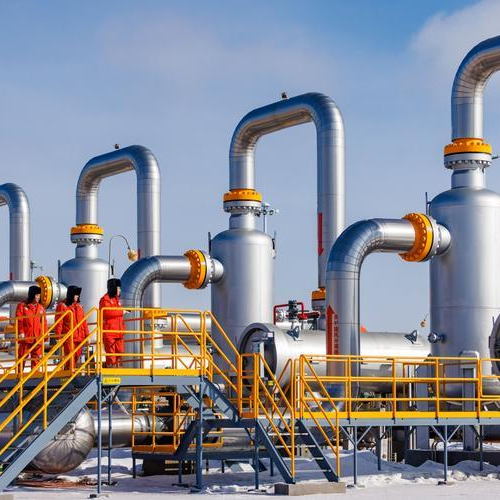
As a key site for processing high-sulfur natural gas, Guangyuan Natural Gas Purification Plant has long faced three major safety challenges:
Ultra-high concentration: H₂S accounts for 50% of the processed natural gas, with a pressure of approximately 80kPa. This poses significant pipeline corrosion risks, and even minor leaks could lead to fatal consequences.
Shortcomings of traditional equipment: Chemical reaction and catalytic combustion monitors have low sensitivity, only detecting high-concentration leaks. They are also prone to interference from cross gases, resulting in high false alarm rates and consuming substantial manpower for annual maintenance and calibration.
Delayed early warning: In the open plant area, traditional equipment often fails to alarm until gas has spread extensively, leaving minimal time for disposal and seriously endangering employees' lives.
In line with Sinopec Group's requirements for intelligent and green development, there was an urgent need for a monitoring system capable of accurately capturing micro-leaks and covering large areas. Guoke Hanhai's TDLAS laser technology emerged as the key to solving this problem.
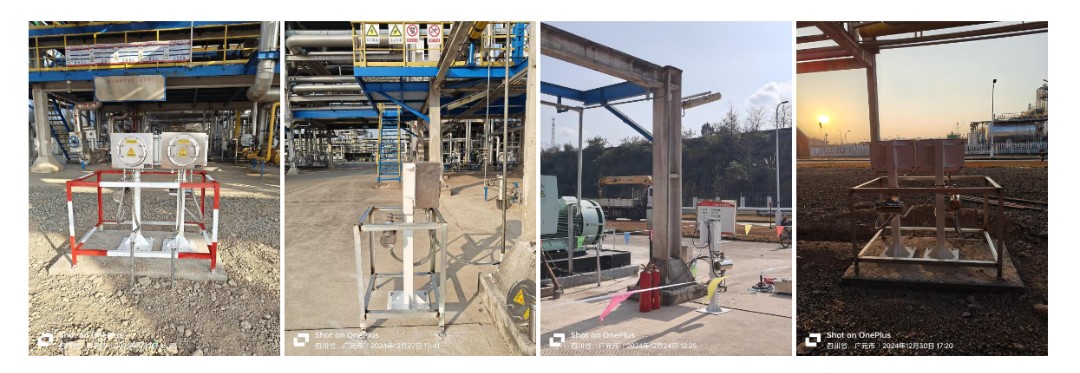
Tailored to the purification plant's risk characteristics, Guoke Hanhai deployed 6 sets of fixed reflective laser gas telemetry instruments, constructing a comprehensive H₂S monitoring network:
In high-leakage-prone areas such as the desulfurization unit and sulfur recovery unit of the No.1 Joint Plant, laser devices are installed in pairs to form a 100-meter-long monitoring optical path. Key monitoring points include pipeline interfaces in the desulfurization unit and valves of sulfur recovery towers – areas most susceptible to leaks due to medium corrosion and frequent operations.
H₂S molecules have a unique spectral "fingerprint". The specific wavelength laser emitted by the laser telemetry instrument is accurately absorbed by H₂S. By analyzing the absorption intensity, the concentration can be calculated, even capturing ppm-level micro-leaks. More importantly, it is not interfered by other gases, fundamentally solving the problem of "rampant false alarms" with traditional equipment.
Real-time monitoring data from the equipment is transmitted to the background server via optical fiber, and the monitoring platform intuitively displays concentrations in various areas. Once exceeding the standard, an acousto-optic alarm is triggered within 1 second, and the leak location is synchronously displayed on the large screen. The entire process from detection to alarm is faster than a human blink, gaining valuable time for emergency disposal.
The commissioning of this laser monitoring system has brought qualitative changes to the purification plant:
Earlier early warning: Traditional equipment only alarms when H₂S concentration reaches tens of ppm, while the laser system captures ppm-level leaks, achieving "early warning of initial leaks". For example, after a maintenance in the desulfurization unit, the system detected a micro-leak at a flange interface, enabling timely disposal and avoiding expanded corrosion.
Wider coverage: A single set of equipment can monitor up to 100 meters. The collaborative networking of 6 devices eliminates blind spots of traditional point monitoring, covering even hard-to-reach areas such as pipeline trenches and equipment tops.
Lower maintenance costs: Laser equipment requires no frequent calibration and has a service life of over 10 years. It reduces maintenance workload by 90% annually and lowers the risk of shutdowns caused by equipment replacement.
More importantly, it transforms the safety management model from "putting out fires after incidents" to "precise prevention and control in advance", sparing employees from the risk of frequent inspections in high-risk areas.
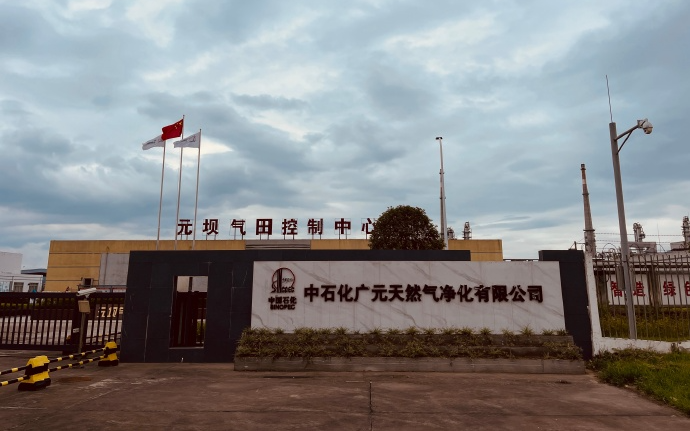
As a pilot project of Sinopec Group, the practice at Guangyuan Purification Plant provides a replicable model for high-sulfur oil & gas field monitoring:
Technological demonstration: It proves that TDLAS laser technology can operate stably in high-concentration and highly corrosive environments, breaking the prejudice that "lasers are afraid of harsh conditions".
Standard upgrading: It promotes the industry's transition from "meeting compliance standards" to "intrinsic safety", providing practical support for the implementation of the "Code for Design of Detection and Alarm of Flammable and Toxic Gases in Petrochemical Industry".
Green synergy: Precise leak control reduces H₂S emissions, helping enterprises achieve a win-win situation between environmental protection and safety.
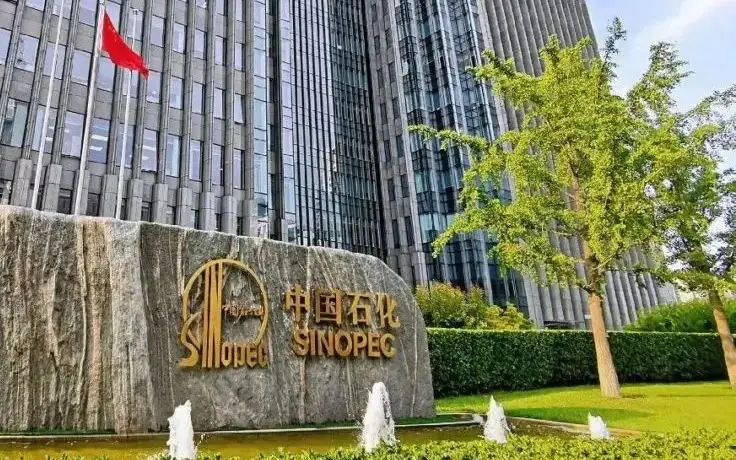
Currently, the project has passed acceptance by Sinopec Group and will be promoted across the entire group next step. Guoke Hanhai is also continuously upgrading its technology, planning to integrate artificial intelligence analysis to enable the system to predict leak trends, moving from "early warning" to "prediction".
On the frontlines of oil & gas extraction, every technological advancement narrows the gap between "risk" and "safety". Guoke Hanhai's laser technology proves that no matter how hidden the "toxin" is, it can be detected by the eyes of science and technology; no matter how severe the challenge is, it cannot stop the determination to protect lives.
TEL:400-055-1239 (9:00~17:00)
MAIL:lisghanhai@gkhhlaser.com
ADDR:302 Floor, Building 5, No. 18, Kechuang 13th Street, Beijing Economic and Technological Development Zone