
ABOUT
Hanhai Opto-electronic is a major scientific research achievement transformation institution of the Hefei Institute of Physical Science, Chinese Academy of Sciences.


Hanhai Opto-electronic is a major scientific research achievement transformation institution of the Hefei Institute of Physical Science, Chinese Academy of Sciences.

Hanhai Optoelectronics centers on laser absorption spectroscopy-based gas detection (TDLAS)technology, developing and manufacturing a full range of products to deliver comprehensive gas detection solutions for cross-field and multi-industry customers.

Hanhai Optoelectronics' laser gas detection products focus on the monitoring of flammable, explosive, toxic and harmful gases as well as greenhouse gases. Leveraging mature technical solutions and flexible product adaptability, these products can be widel

With over a decade of technical accumulation and recognition from nearly a hundred customers, Hanhai Optoelectronics' laser gas detection products have delivered successful cases covering core scenarios across petrochemicals, urban gas, environmental moni

The company's core technology has been jointly recommended by the Ministry of Emergency Management, the Ministry of Science and Technology, and the Ministry of Industry and Information Technology.
China Green Fuel Development Report 2026
In‑depth Interpretation of Key Report
Guoke Hanhai’s TDLAS Builds Dual Foundations for Safety and Compliance of Green Ammonia and Green Methanol
Recently, China Green Fuel Development Report (2026), compiled under the leadership of the Department of Energy Conservation and Science‑Technology Equipment of the National Energy Administration, has been officially released. It systematically sorts out the industrial status and development prospects of green methanol, green synthetic ammonia, green aviation fuel, bio‑natural gas and other categories in China. The report identifies the 15th Five‑Year Plan period as the cultivation and development phase for the green fuel industry. As its kick‑off year, 2026 will witness accelerated technological research, pilot implementation and scenario expansion.
Green fuel serves as a core enabler for China’s energy transition and dual‑carbon strategy, as well as a practical decarbonization pathway for shipping, chemical and aviation sectors. Alongside rapid capacity expansion and accelerated deployment of application scenarios, safety control over fuel leakage and accurate full‑lifecycle carbon emission accounting have become core shortcomings that must be addressed for large‑scale industrial development. Drawing on self‑developed and controllable TDLAS (Tunable Diode Laser Absorption Spectroscopy) technology, Guoke Hanhai has developed gas monitoring solutions covering the whole chain of production, storage‑transportation, refueling and end‑use applications. With intrinsically‑safe laser perception capabilities, it establishes dual foundations for safety early‑warning and carbon compliance for the high‑quality development of the green fuel industry.
01 Driven by Dual Forces of Policy and Industry, Green Fuel Enters Accelerated Development Phase
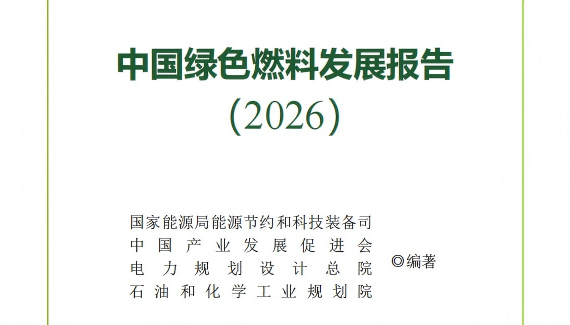
According to the report, China’s green fuel industry has achieved sound progress featuring improved policy frameworks, initial capacity scale and expanding application scenarios, emerging as a new growth point prioritized by national policies:
Full roll‑out of top‑level design: From the Renewable Energy Law and Energy Law, to industrial‑structure adjustment incentive catalogues and special‑purpose pilots for green liquid fuels, China has formulated a full‑chain supporting policy system covering production, application, fiscal‑tax incentives and certification. The 15th Five‑Year Plan will advance systematic planning for the complete industrial chain.
Globally leading production capacity: By the end of 2025, China’s green methanol capacity reached 380 000 tons per annum, accounting for 60.3 % of the global total. Green synthetic ammonia capacity hit 700 000 tons per annum, taking up 79.5 % of global output. Both flagship products rank first worldwide, laying a solid industrial foundation for scaled‑up development.
Expanding application boundaries: Its scope of use is rapidly extending from land‑based transportation to shipping, aviation and industrial sectors. For shipping, bunkering modes for green methanol, green ammonia and biodiesel have been realized, with regular refueling operations available at ports including Shanghai, Qingdao and Dalian. In industrial fields, pilot projects such as green‑ammonia co‑firing and green‑methanol substitution for chemical feedstocks are being rolled out at an accelerated pace.
Beneath the rapid industrial expansion, safety and compliance represent non‑negotiable bottom lines. Green ammonia and green methanol are flammable‑explosive, toxic and corrosive substances, posing prominent leakage risks throughout production, storage‑transportation, refueling and marine application processes. Meanwhile, decarbonization‑intensity certification for green fuels and MRV (Monitoring, Reporting and Verification)‑based carbon‑emission accounting impose stringent requirements on monitoring data accuracy and traceability. Conventional electrochemical, catalytic‑combustion and ordinary infrared sensors can no longer satisfy the rigorous demands of green‑fuel scenarios.
02 Prominent Risks for Three Major Fuel Categories: Underlying Drawbacks of Traditional Sensing Solutions
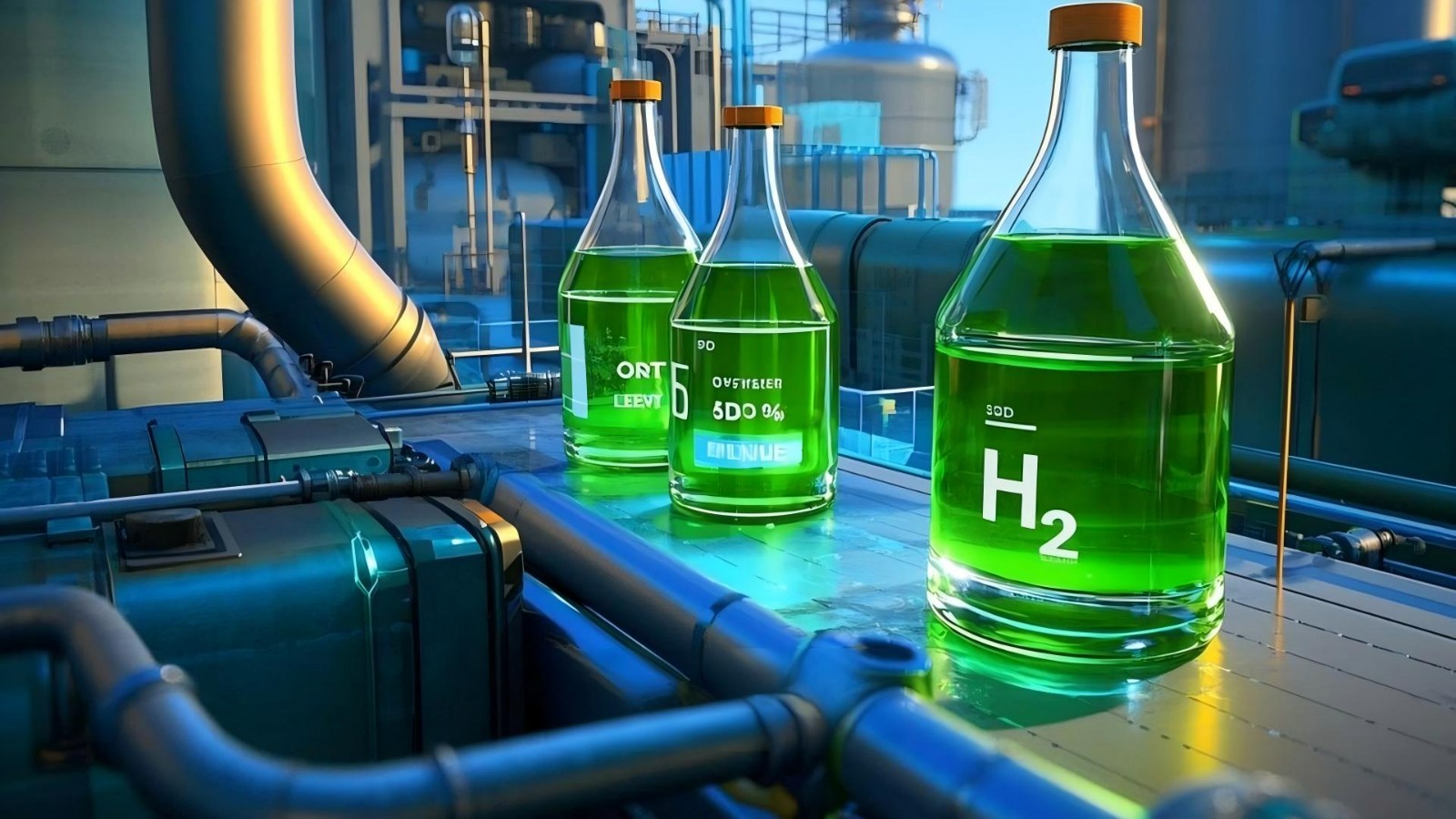
Green fuels vary greatly in physical‑chemical properties and place higher requirements on monitoring technologies, while conventional devices suffer from inherent hard‑to‑remedy pain points:
Green synthetic ammonia: rapid sensor failure caused by strong corrosion
Ammonia is toxic, flammable‑explosive and highly corrosive. Even minor leakage may lead to personnel poisoning and deflagration hazards. Electrochemical sensors undergo rapid corrosion upon ammonia exposure, causing irreversible electrode damage and sharp sensitivity degradation, which easily result in missed alarms. Ordinary infrared sensors are severely interfered with by water vapor and miscellaneous gases, delivering insufficient accuracy for low‑concentration leakage detection and failing to meet early‑warning requirements.
Green methanol: invisible vapor and numerous interference factors
Methanol vapor is colorless with a wide explosive range, making early‑stage leakage hard to detect manually. Traditional sensors are vulnerable to cross‑interference from fuel vapor and cabin‑borne miscellaneous gases, triggering frequent false and missed alarms. Moreover, high salt‑fog and high‑humidity conditions at ports and onboard vessels accelerate equipment ageing and severe long‑term data drift. Such performance cannot support safety early‑warning nor meet precision requirements for carbon‑accounting data.
Bio‑natural gas / methane: difficulty quantifying fugitive emissions
Methane constitutes the core component of bio‑natural gas. Fugitive emissions from storage tanks, pipe networks and refueling points are scattered and concealed. Traditional single‑point monitoring devices have limited coverage and cannot realize accurate quantification of full‑domain fugitive emissions. Poor data stability impedes methane‑emission‑reduction accounting and third‑party certification for green‑fuel decarbonization intensity.
03 Generational Advantages of TDLAS: Addressing Dual Challenges of Safety and Compliance
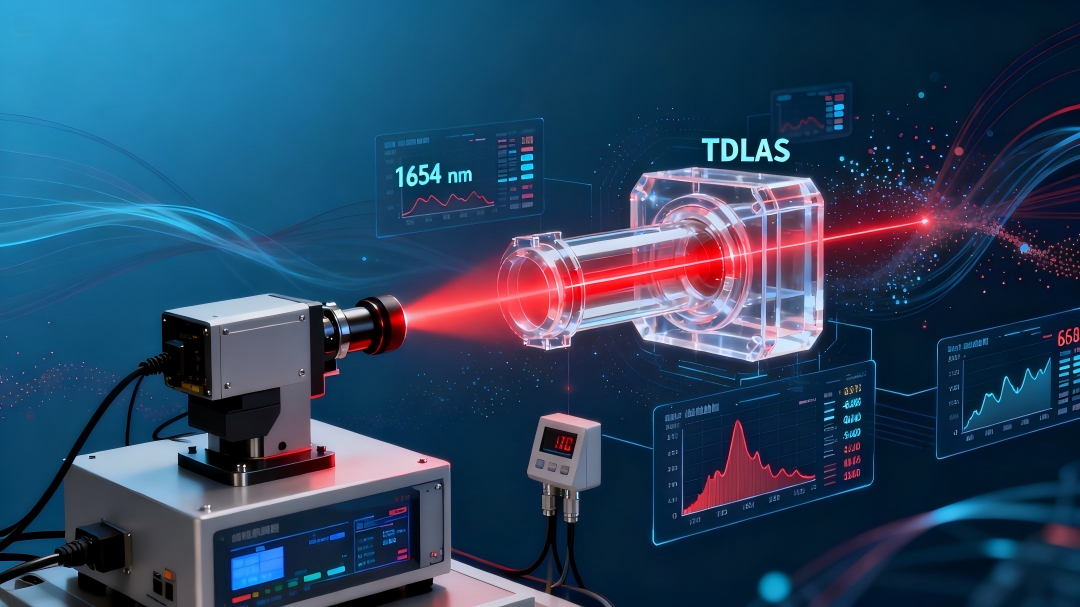
Guoke Hanhai’s self‑developed TDLAS technology adopts pure‑physical molecular‑fingerprint identification, eliminating inherent defects of traditional sensors at the root and comprehensively meeting full‑scene demands for green‑fuel safety monitoring and carbon compliance:
Intrinsic anti‑interference capability, zero poisoning‑induced failure throughout service life
Free of catalytic or electrochemical consumables, it resists interference from ammonia corrosion, methanol vapor, salt fog, oil contamination and water vapor. It maintains zero baseline drift during long‑term operation and delivers credible 7×24‑hour monitoring data. Well‑suited for harsh working conditions such as production plants, coastal ports and ship engine rooms, it fundamentally solves the chronic problems of short service life and inaccurate measurement plaguing conventional equipment.
ppb‑level ultra‑high sensitivity for early‑stage leakage warning
Capable of precisely detecting more than ten types of gases including ammonia, methanol, methane and hydrogen sulfide. Its ppb‑level sensitivity captures micro‑leakages from flanges, valves and refueling nozzles with millisecond‑level response. Hierarchical early‑warnings are triggered before gas concentrations reach poisoning or explosion thresholds, reserving sufficient response windows and curbing risks at embryonic stages.
Traceable data supporting carbon accounting and green certification
Fully traceable and auditable non‑tamperable monitoring data supports closed‑loop LDAR (Leak Detection and Repair) management for enterprises, complying with regulatory requirements of the Eco‑Civilization Code of China and Dangerous Chemicals Safety Law. In addition, it enables accurate quantification of fugitive emissions, supplying authentic raw data for green‑fuel decarbonization‑intensity calculation, MRV carbon‑emission verification and CCER voluntary emission‑reduction trading, helping enterprises materialize green‑value benefits.
04 Full‑chain Product Portfolio Covering Whole‑life‑cycle Green‑fuel Scenarios
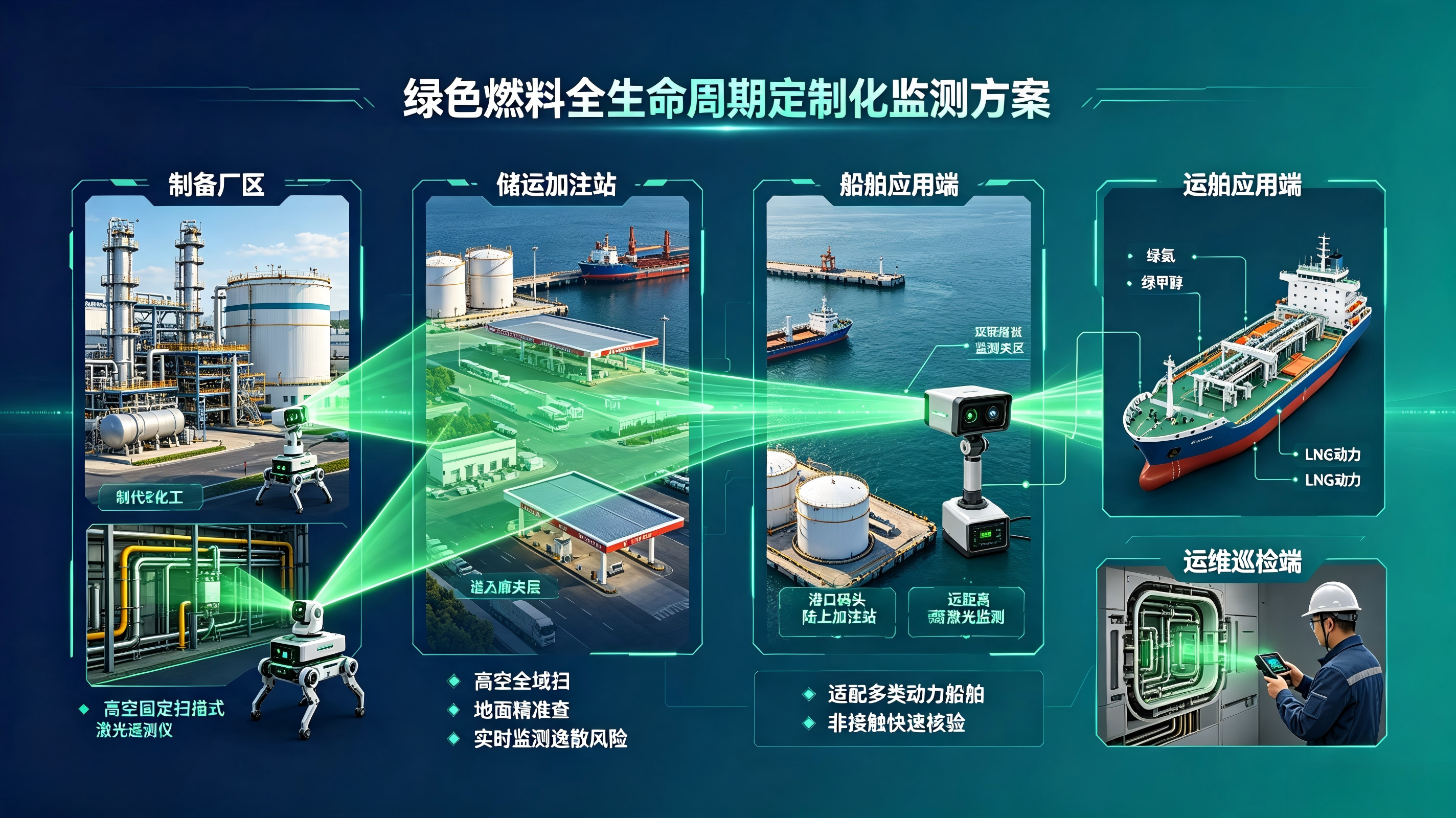
Backed by a complete TDLAS‑based product portfolio, Guoke Hanhai provides customized monitoring solutions for the full lifecycle of green fuels:
Production plants: Fixed scanning laser telemeters perform 360° omnidirectional scanning of process units and tank zones. Paired with quadruped robots carrying pump‑sampling laser analyzers to inspect equipment interlayers and pipe‑gallery dead corners, a three‑dimensional prevention‑and‑control network is built combining “high‑altitude full‑area scanning + ground‑based precise inspection”.
Storage, transportation and refueling stations: Long‑range laser telemetry devices are deployed at coastal and inland refueling terminals to cover refueling zones and tank farms, real‑time monitoring fugitive‑emission risks during refueling operations and protecting on‑site personnel.
Onboard marine applications: Special‑purpose marine laser monitoring systems are tailored for green‑ammonia, green‑methanol and LNG‑powered vessels, covering fuel tanks, engine rooms and double‑wall pipe interlayers, satisfying both marine‑safety specifications and maritime‑emission‑verification requirements.
Operation‑and‑maintenance inspection: Portable laser detectors for front‑line field staff realize non‑contact rapid verification of suspected leakage points and reduce safety risks during inspection work.
Conclusion
China Green Fuel Development Report (2026) outlines a clear roadmap for industrial large‑scale development while raising higher bars for safety assurance and technical support. Safety constitutes the bottom line for green‑fuel industrial growth, and credible data serves as the foundation for carbon compliance and realization of green value.
As a leading domestic enterprise in laser‑based gas detection, Guoke Hanhai will continue to deepen TDLAS core‑technology R&D, actively participate in the formulation of green‑fuel industrial standards, and iteratively upgrade special‑purpose monitoring equipment for green ammonia, green methanol, bio‑natural gas and other fuels. Leveraging domestically‑developed and controllable laser technologies, the company will underpin the safe, compliant and high‑quality growth of China’s green‑fuel industry and facilitate the delivery of national energy‑transition and dual‑carbon objectives.
TEL:400-055-1239 (9:00~17:00)
MAIL:lisghanhai@gkhhlaser.com
ADDR:302 Floor, Building 5, No. 18, Kechuang 13th Street, Beijing Economic and Technological Development Zone