
ABOUT
Hanhai Opto-electronic is a major scientific research achievement transformation institution of the Hefei Institute of Physical Science, Chinese Academy of Sciences.


Hanhai Opto-electronic is a major scientific research achievement transformation institution of the Hefei Institute of Physical Science, Chinese Academy of Sciences.

Hanhai Optoelectronics centers on laser absorption spectroscopy-based gas detection (TDLAS)technology, developing and manufacturing a full range of products to deliver comprehensive gas detection solutions for cross-field and multi-industry customers.

Hanhai Optoelectronics' laser gas detection products focus on the monitoring of flammable, explosive, toxic and harmful gases as well as greenhouse gases. Leveraging mature technical solutions and flexible product adaptability, these products can be widel

With over a decade of technical accumulation and recognition from nearly a hundred customers, Hanhai Optoelectronics' laser gas detection products have delivered successful cases covering core scenarios across petrochemicals, urban gas, environmental moni

The company's core technology has been jointly recommended by the Ministry of Emergency Management, the Ministry of Science and Technology, and the Ministry of Industry and Information Technology.
I. Project Background
Petrochemical parks house numerous high-risk units including tank farms, production plants, and loading/unloading zones. The flammable, explosive, toxic, and harmful gases involved in production, storage, and transportation processes (e.g., methane, hydrogen sulfide, carbon monoxide) are characterized by high leakage susceptibility, rapid diffusion, and extreme hazard potential.
Traditional boundary gas monitoring in parks relies primarily on single-point sensor deployment, which suffers from critical limitations such as extensive coverage blind spots, delayed response, and weak anti-interference capability. In the event of gas leakage, this approach fails to promptly pinpoint the leak source and trigger early warnings, potentially leading to catastrophic safety incidents including fires, explosions, and personnel poisoning.
With the continuous tightening of national safety regulatory requirements for chemical parks, policies such as the Three-Year Action Plan for Special Rectification of Hazardous Chemical Safety and the Guidelines for Safety Risk Investigation and Control in Chemical Parks explicitly mandate the establishment of comprehensive, multi-dimensional, and intelligent safety monitoring and early warning systems. Leveraging its inherent advantages of high sensitivity, superior selectivity, and long-distance non-contact detection, laser gas monitoring technology has emerged as the core technical solution for building a robust gas boundary protection network in industrial parks.
II. Key Pain Points in Application Scenarios
Challenge of Large-Scale Open Boundary Monitoring
Petrochemical park boundaries are typically extensive and feature complex terrain (including green belts, roads, and ditches). Traditional point sensors cannot achieve full-area coverage, leaving substantial blind spots that fail to prevent gas diffusion from boundary gaps to public areas outside the park.
Insufficient Monitoring Accuracy Under Complex Operating Conditions
Adverse environmental factors in parks, such as dust, extreme temperature and humidity fluctuations, and electromagnetic interference, frequently cause traditional sensors to generate false alarms or miss real leaks. This results in unnecessary patrols by maintenance personnel and significant waste of human resources.
Demand for Rapid Response and Precise Localization in Leak Incidents
Gas leaks are inherently sudden. Conventional monitoring systems are plagued by slow response times and inability to accurately locate leak points, failing to provide actionable data for emergency response and potentially exacerbating accident severity.
Demand for Multi-source Data Fusion and Unified Management
Existing safety systems in parks (e.g., DCS, fire protection systems, video surveillance systems) operate in isolation, with no data interoperability. This fragmentation hinders the realization of an integrated "monitoring-warning-response" linkage mechanism.
III. Solution Design
(I) Core Design Philosophy
Centered on laser gas monitoring technology, this solution establishes a three-in-one park gas boundary protection system consisting of "long-distance laser monitoring lines + intelligent early warning platform + emergency linkage mechanism". It enables real-time, full-coverage, and precise monitoring of flammable, explosive, toxic, and harmful gases. Upon detection of gas leakage, the system immediately triggers tiered early warnings to safeguard the safety of park personnel and the surrounding environment.
(II) Core Technology and Equipment Deployment
Core Monitoring Equipment
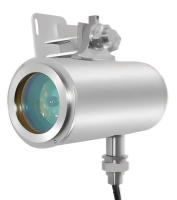
Fixed Reflective Laser Gas Telemetry Analyzers: Deployed at intervals along park boundaries, these devices adopt Tunable Diode Laser Absorption Spectroscopy (TDLAS) technology to enable non-contact, long-distance monitoring. They accurately measure target gas concentrations with immunity to interference from dust, water vapor, and other contaminants.
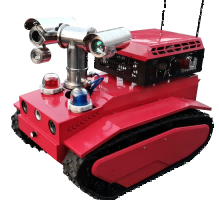
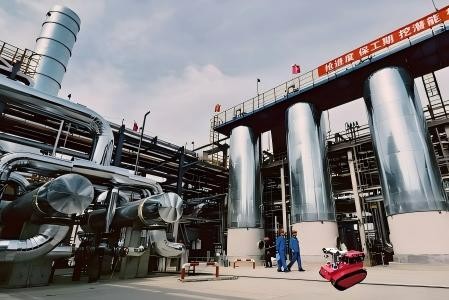
Hazardous Gas Laser Detection Robots: Deployed in key boundary areas (e.g., tank farm entrances/exits, loading/unloading zone boundaries), these robots feature autonomous patrol capabilities to provide real-time supplementary monitoring and eliminate blind spots left by fixed devices.
Deployment Scheme
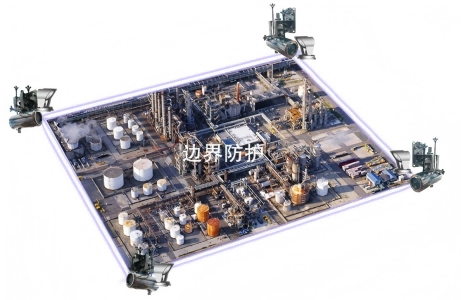
Primary Defense Line (Outer Park Boundary): Long-distance laser gas telemetry analyzers are installed along the outer side of the park's physical perimeter fence to form a continuous laser monitoring belt, preventing gas leakage to areas outside the park.
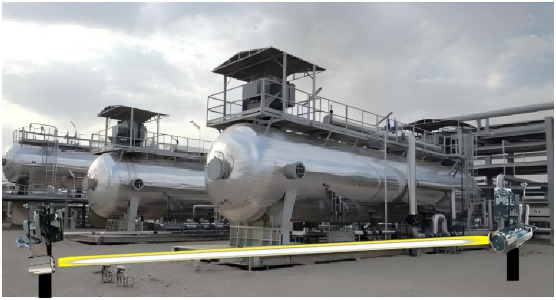
Secondary Defense Line (Boundaries of High-Risk Zones Inside the Park): A combination of laser gas telemetry analyzers and patrol robots is deployed around high-risk units such as tank farms and production plants to achieve dual-layer monitoring and provide early warnings of leakage risks.
IV. Solution Summary
Based on laser gas monitoring technology, this solution directly addresses the core pain points of boundary gas monitoring in petrochemical parks, including incomplete coverage, delayed response, and insufficient accuracy. By constructing a protection system featuring "full-area monitoring, intelligent early warning, and coordinated response", the solution enables early warning, precise localization, and rapid mitigation of gas leakage risks in the park.
The implementation of this solution will effectively reduce the incidence of safety accidents such as fires, explosions, and personnel poisoning, ensuring the occupational safety of park staff. Simultaneously, it will help parks meet national safety regulatory requirements and enhance the intelligence and refinement level of park safety management.
V. Solution Advantages
Advanced Technology: Adopts TDLAS laser monitoring technology with strong anti-interference capability, delivering monitoring accuracy and response speed far superior to traditional sensors.
Full-Scenario Coverage: Combines fixed monitoring and mobile patrol modes to achieve blind-spot-free coverage, adaptable to complex terrain and operating conditions.
High Intelligence: Enables multi-system linkage and data fusion, reducing manual intervention and lowering operation and maintenance costs.
Policy Compliance: Fully aligns with national requirements for the construction of chemical park safety monitoring and early warning systems, facilitating parks in passing safety rating assessments.
TEL:400-055-1239 (9:00~17:00)
MAIL:lisghanhai@gkhhlaser.com
ADDR:302 Floor, Building 5, No. 18, Kechuang 13th Street, Beijing Economic and Technological Development Zone